

Wide-Open Down-Ballot Primaries with High Undecided Voters

Two-Thirds of AZ Voters Undecided in Most Statewide Primaries
PHOENIX (March 11, 2026)- A new Arizona Public Opinion Pulse (AZPOP) poll from Noble Predictive Insights (NPI) finds several down-ballot statewide races largely unsettled heading into the 2026 cycle, with substantial shares of primary voters undecided and no clear front-runners emerging in multiple contests.
This AZPOP, conducted from February 23-26, 2026, surveyed 1023 registered voters in Arizona, yielding a margin of error of ± 3.06%. The total sample included 384 registered Republicans, yielding a margin of error of ± 4.99%, and 333 Democrats, yielding a margin of error of ± 5.37%.
The data suggest that while top-of-ticket races are beginning to crystallize, lower-profile contests for Secretary of State, Attorney General, and Superintendent of Public Instruction remain fluid — and highly competitive.
Secretary of State (Republican Primary)
In the Republican primary for Secretary of State, the race is still wide open:

Two-thirds of Republican voters remain undecided, indicating extremely low candidate definition at this stage. Younger Republican voters (ages 18–29) show stronger early support for Kolodin (36%), while older voters (65+) are overwhelmingly undecided (88%). Swoboda does not significantly lead Kolodin among any key demographics.
“This is a classic low-information primary,” said Mike Noble, NPI Founder & CEO. “With 67% undecided, this race hasn’t even begun to fully form. The candidate who can build early name ID and consolidate a coalition of older primary voters will have a major advantage.”
Favorability and name recognition numbers show why the race remains fluid.
Kolodin:
· Total Favorable: 16%
· Total Unfavorable: 15%
· Net Favorability: +1
· Name ID: 56%
Swoboda:
· Total Favorable: 17%
· Total Unfavorable: 17%
· Net Favorability: +/-0
· Name ID: 60%
“This race is still almost entirely defined by name recognition,” said Mike Noble, Founder and CEO of Noble Predictive Insights. “Kolodin’s financial advantage allows him to begin introducing himself to voters while the race is still largely undefined.”
Attorney General (Republican Primary)
The Republican primary for Attorney General shows a similarly unsettled electorate:

Again, two-thirds of voters are undecided. Petersen performs best among younger Republicans (33% among 18–29 year olds), while older voters remain largely undecided (87% among seniors). Glassman performs better with Pima County Republicans (21%).
Glassman:
· Total Favorable: 17%
· Total Unfavorable: 14%
· Net Favorability: +3
· Name ID: 54%
Peterson:
· Total Favorable: 17%
· Total Unfavorable: 14%
· Net Favorability: +3
· Name ID: 55%
Roeberg:
· Total Favorable: 17%
· Total Unfavorable: 12%
· Net Favorability: +5
· Name ID: 52%
“The Attorney General race mirrors the Secretary of State contest — high uncertainty and no dominant candidate,” Mike Noble noted. “With voters still shopping, this is a race that could shift dramatically once campaigns begin communicating at scale.”
Superintendent of Public Instruction (Republican Primary)
The Superintendent’s race shows more definition but remains competitive:

Horne holds a modest lead, particularly among male voters (36%), while Yee performs slightly better with younger voters aged 18–44. However, with 44% undecided, the race remains highly fluid — especially among women, where 52% remain undecided.
Horne:
· Total Favorable: 26%
· Total Unfavorable: 24%
· Net Favorability: +2
· Name ID: 72%
Yee:
· Total Favorable: 27%
· Total Unfavorable: 13%
· Net Favorability: +14
· Name ID: 62%
“This is the most developed of the Republican down-ballot primaries, but even here, nearly half of voters are still uncommitted,” said Noble. “There is room for movement, particularly among women and middle-aged voters.”
Democratic Primary for Superintendent
On the Democratic side, the Superintendent primary is even less settled:

Ruiz begins with a clear early advantage, but nearly two-thirds of Democratic voters remain undecided. Undecided numbers climb to 80% among voters 65 and older, suggesting minimal engagement thus far.
Butts:
· Total Favorable: 17%
· Total Unfavorable: 12%
· Net Favorability: +5
· Name ID: 53%
Ruiz:
· Total Favorable: 20%
· Total Unfavorable: 11%
· Net Favorability: +9
· Name ID: 55%
Arizona Corporation Commission
The race for the Arizona Corporation Commission also reflects extremely low voter familiarity. In the GOP and Democratic Primaries, voters may select up to two candidates, producing the following early support levels:

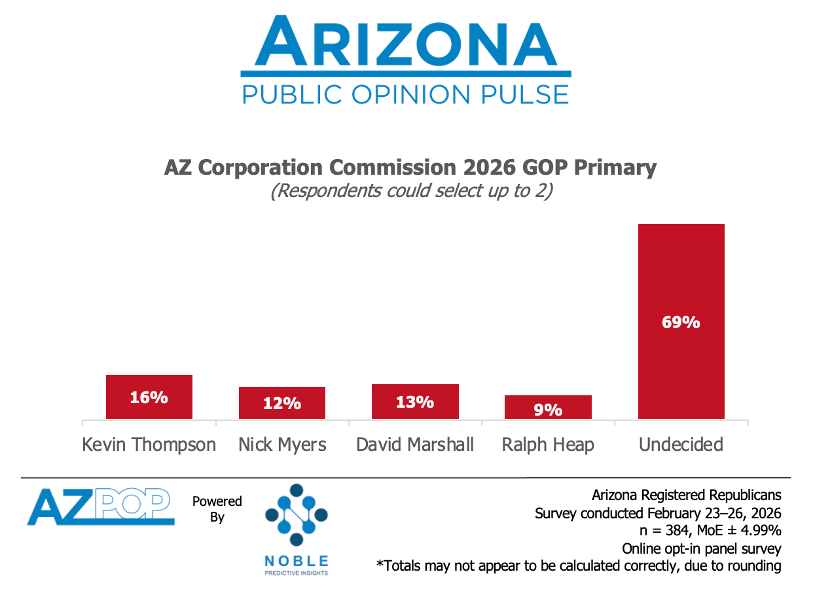
Favorability and name recognition numbers for both parties’ candidates reveal the same early-cycle dynamic seen across other down-ballot contests. Most voters either have no opinion of or have never heard of these candidates, indicating the race is still in its earliest stages.
“The Corporation Commission is historically one of the lowest-profile statewide offices,” Noble said. “When voters haven’t formed impressions yet, campaigns that can introduce their candidates effectively — particularly on issues like energy costs and utility regulation — can move the race quickly.”
Because voters may select multiple candidates in this race, support levels are more fragmented than in single-seat contests, making name recognition and campaign resources particularly important.
Key Takeaways
Across nearly every down-ballot contest tested, the dominant story is the size of the undecided vote. In three of the four primaries examined, roughly two-thirds of voters remain uncommitted.
Younger voters show more volatility and are somewhat more likely to select a candidate.
Older voters — typically the most reliable primary participants — remain disproportionately undecided.
No candidate in these down-ballot contests currently commands majority or near-majority support.
“These numbers reflect early-cycle dynamics,” Noble said. “Voters simply aren’t tuned into these races yet. But that also means campaigns have plenty of opportunity. Definition — positive or negative — will matter immensely.”
As the 2026 cycle unfolds, Arizona’s down-ballot primaries are shaping up to be competitive, volatile, and highly dependent on candidate engagement and turnout dynamics.
###
Methodology: This poll was conducted as an online opt-in panel survey. The survey was completed by Noble Predictive Insights from February 23-26, 2026 from an Arizona statewide registered voter sample. The sample demographics were weighted to accurately reflect gender, region, age, party affiliation, ethnicity, and education according to recent voter file data, the Arizona Secretary of State’s Office, and recent Census data. The sample size was 1023 registered voters, yielding a MoE of ± 3.06%. The total sample included 384 registered Republicans, yielding a margin of error of ± 4.99%, and 333 Democrats, yielding a margin of error of ± 5.37%. Numbers may not equal 100% due to rounding.
Media Contact:
Veronica Sutliff, Noble Predictive Insights, v.sutliff@npredictive.com, (602) 390-5248
About Noble Predictive Insights: As a nonpartisan public opinion polling, market research, and data analytics firm, Noble Predictive Insights exists to transform how leaders make decisions by delivering data-based solutions and predictive insights that provide a clear path forward. We bridge the gap between research and strategy with customized strategic research, a hyper-focus on impact, and being true partners with our clients. Noble Predictive Insights (formerly OH Predictive Insights) is a 2023 Inc. 5000 fastest-growing company in the Southwest region, and is ranked in the top 15 most accurate pollsters as well as in the top 5 for lowest average bias in the 2021-22 election cycle by FiveThirtyEight. For more information, please call (602) 641-6565 or visit our website at www.noblepredictiveinsights.com.


