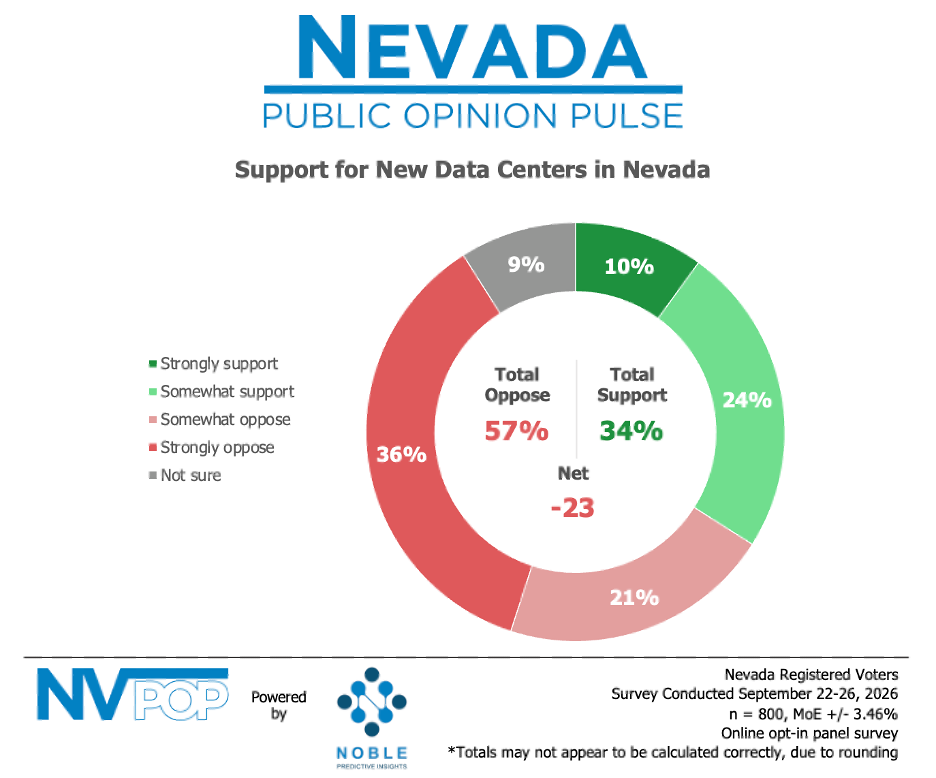
Arizona Voters Want the Brakes Put on New Data Centers

Majorities Across Party Lines Favor Limits Over Additional Development
PHOENIX (August 26, 2026)- Arizona voters are skeptical of additional large data-center development – and become even more decisive when asked to weigh investment against pressure on state resources – according to Noble Predictive Insights’ (NPI) most recent Arizona Public Opinion Pulse (AZPOP).
This AZPOP was conducted from August 10-13, 2026, and surveyed 1040 registered Arizona voters in Arizona, including 923 likely voters, yielding margins of error of ±3.0% and ±3.2%, respectively.
A majority of registered voters oppose the construction of additional large data centers in Arizona, while 30% support more development and 13% are unsure.

The intensity of opinion is concentrated on the opposition side. Strong opponents outnumber strong supporters by nearly 4:1 – more than one-third (35%) strongly oppose additional large data centers, compared with just 9% who strongly support them.
“Voters are not mildly skeptical,” said Mike Noble, NPI Founder & CEO. “The intensity is on the opposition side: strong opponents outnumber strong supporters by nearly 4:1.”
The skepticism becomes even more pronounced when voters are asked to choose between economic development and resource constraints. Nearly two-thirds (61%) say Arizona should limit additional data-center development because of water use, electricity demand, and infrastructure costs. Only 18% say the state should encourage more development because of potential investment and tax revenue.
The Tradeoff Creates a Bipartisan Majority
Limiting additional development draws majority support across the political spectrum: 54% of Republicans, 71% of Democrats, and 61% of Independents choose limits. Republicans are the most open to additional development, but even among GOP voters the limit position leads encouragement by 27 points.

The same pattern holds across ideology: 78% of liberals, 60% of moderates, and 52% of conservatives prefer limits. Even among Trump-first Republicans, 51% choose limits, compared with 32% who prioritize encouraging development.
The same consensus spans Arizona's communities. The share favoring limits rises from 59% in urban areas to 62% in suburban communities and 64% in rural Arizona.

“Investment and tax revenue are attractive words, but they do not close the sale,” said Noble. “When the question includes water, power and infrastructure, limits win in every major political group.”
Republicans Are Split on the General Question
Republicans are much less opposed than Democrats or Independents when asked the general support-or-oppose question. Among registered Republicans, 42% support and 46% oppose additional data centers — a statistical tie within the subgroup’s margin of error.
The split is sharper inside the GOP. Trump-first Republicans support additional data centers 49% to 37%, while party-first Republicans oppose them 53% to 37%. But when water, electricity and infrastructure are added to the tradeoff, majorities in both groups move toward limits.

“Republicans are not monolithic here,” said Noble. “Trump-first voters are more open to new data centers in the abstract, while party-first Republicans are more skeptical. Once the costs are spelled out, both groups move toward limits.”
The Issue Reaches the Governor’s Race
Arizona voters also give Hobbs an advantage over Biggs on managing the growth and impacts of data centers. Hobbs is trusted more by 39%, compared with 30% for Biggs; 11% trust both equally, 13% trust neither, and 8% are unsure.
“Data centers are no longer a niche land-use question,” said Noble. “Voters connect them to water, electric demand and infrastructure — and they are carrying that judgment into the governor’s race.”

Mike Noble’s final insight on this data: "Data centers have moved from an economic-development talking point to a test of governing competence. The candidate who can show voters a credible plan for water, electricity, and infrastructure will have the advantage on this issue."
###
Methodology: This poll was conducted by Noble Predictive Insights from August 10-13, 2026, and surveyed Arizona registered voters via opt-in online panel. In total, we interviewed 1040 registered voters and 923 likely voters (determined via screening questions). The sample demographics were weighted to accurately reflect the registered voter population by gender, region, age, party affiliation, race/ethnicity, and education according to recent voter file data, the Arizona Secretary of State’s Office, and recent Census data. The likely voter subgroup was weighted by the same demographic categories although modeled to NPI’s current projected turnout of the electorate. The margin of error was +/- 3.04% for registered voters and +/- 3.23% for likely voters. *Numbers may not total 100%, due to rounding.
Media Contact:
Veronica Sutliff, Noble Predictive Insights, v.sutliff@npredictive.com, (602) 390-5248
About Noble Predictive Insights: As a nonpartisan public opinion polling, market research, and data analytics firm, Noble Predictive Insights exists to transform how leaders make decisions by delivering data-based solutions and predictive insights that provide a clear path forward. We bridge the gap between research and strategy with customized strategic research, a hyper-focus on impact, and being true partners with our clients. Noble Predictive Insights (formerly OH Predictive Insights) is a 2023 Inc. 5000 fastest-growing company in the Southwest region, and is ranked in the top 15 most accurate pollsters as well as in the top 5 for lowest average bias in the 2021-22 election cycle by FiveThirtyEight. For more information, please call (602) 641-6565 or visit our website at www.noblepredictiveinsights.com.